

The QA Engineer Was the Right Answer the Whole Time

The QA engineer role in agentic software development is not a support function anymore. It is the whole job. In an agent fleet, quality moves almost entirely into the frame you write before execution starts, and the one layer still bound to a human, validating the output, thins out and becomes the bottleneck. QA is the engineer who already lives in the frame. Everyone else is late.
The frame is where quality lives now
Here is what changed the moment you handed your developers Claude Code subscriptions. The executor inside the frame moved. It used to be a human typing. Now it is an agent, or fifty of them, burning tokens at 3am. The discipline did not change. Delivery was always about making framing and validation manageable, scalable, predictable. What died was the operating model underneath it, the one the industry has sat on since day one, where a human writes the code and a human reviews the code and quality is whatever survives that handoff.
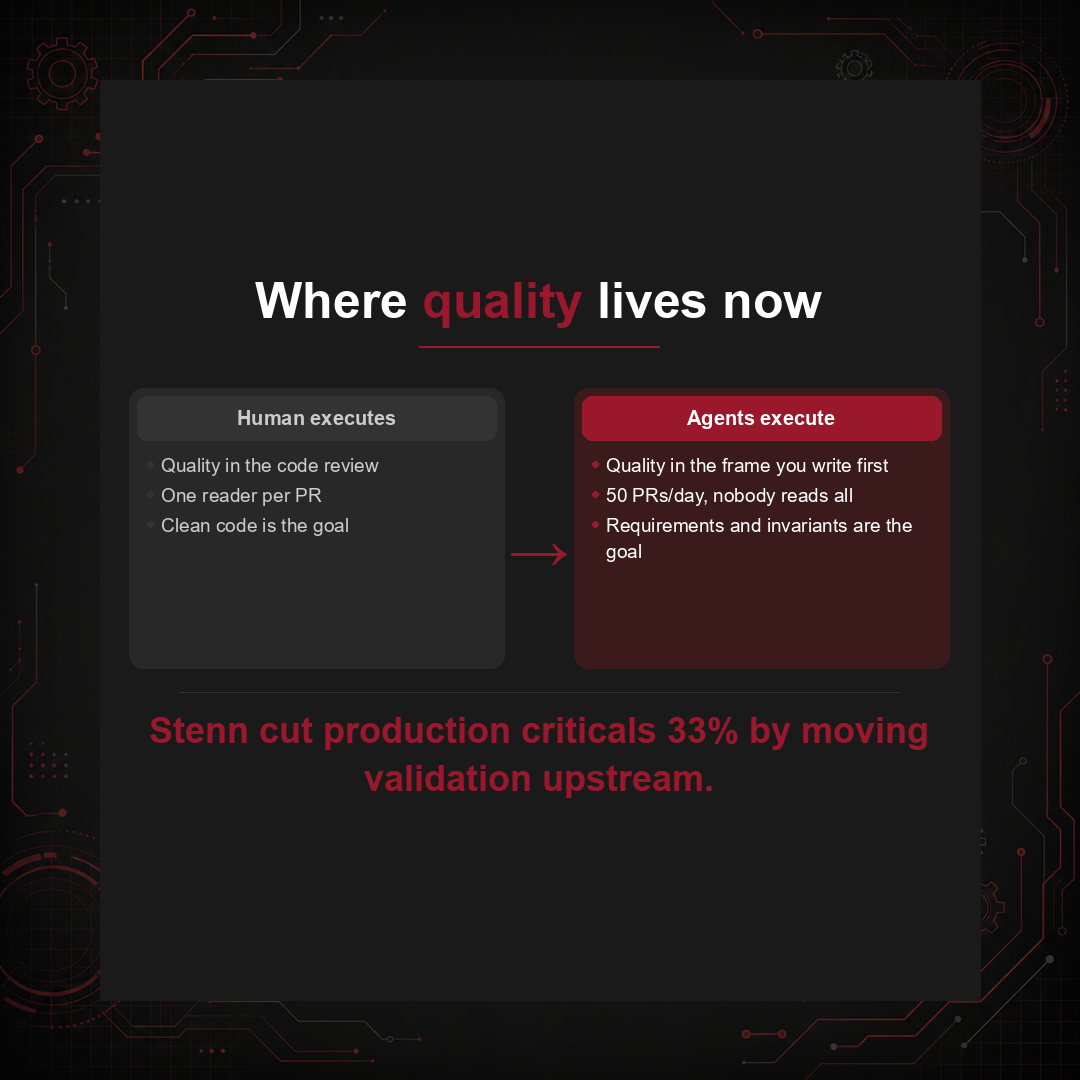
Agents do not read your intent. They read your frame. If the invariants of the system are not in the frame, they are not in the output. This is the part the industry keeps refusing to see. We got fast at everything else. We write docs in seconds, spawn hundreds of agents, generate more code before lunch than a team shipped in a quarter. And the output is still slop, every single time. Not because the models are weak. Because quality was never put into the frame. It was left for a human to catch at the end, and a human does not scale to 50 PRs a day.
Why output validation is the bottleneck, not the problem
Let me be exact, because this is where most people writing about agentic dev get lazy. Output validation is critical. It is not the enemy. It is the bottleneck, and those are different words. A bottleneck is a good thing running out of capacity, not a bad thing to delete.
You see the LinkedIn complaint everywhere: developers do not even look at what the model produced. Half right. The half that is right is that post-hoc human review does not scale and never will. The half that is wrong is the moralizing. Screaming at engineers for being lazy while the queue grows to 50 PRs a day is screaming yourself out of a job. The engineer is not the failure. The placement of the check is the failure. You put the only human-bound step at the tail of the pipeline, then act surprised when it clogs.
For 20 years QA was the role you apologized for. The team you cut first, the title juniors wanted to escape, the black mark. And it turns out QA was the product-team engineer from the future the entire time, usable today, at absurd leverage, if you stop wearing the clean-code glasses long enough to see it.
QA solved this exact shape of problem 20 years ago. It has a name. It is called shift-left. You do not cure a bottleneck bound to human time by adding more heroics at the moment of impact. You move the action left on the timeline, to where it is cheaper. Catching a defect in the frame costs minutes. Catching it in production, after fifty agents propagated it across the codebase, costs you a weekend and your on-call engineer's trust.
What does shift-left actually mean for an agent fleet?
Shift-left for an agent fleet means the quality gate moves from reviewing output to preparing input. Concretely: two human gates, one at the input and one at the output, and everything in the middle runs autonomous by design. The input gate is where the real leverage sits, because that is the frame the whole fleet executes inside. Get the frame right and the middle stays clean without you watching it.
I learned the price of a bad frame the expensive way. On one content pipeline I generated 1300 articles. The discipline that made that work was not the generation step, which is trivial, it was the preparation. Every article that came back wrong told me exactly one thing: something in the input was underspecified. So you fix the input, not the article. And here is the mechanism that compounds. Every return that fixes the input retires a defect class forever. You do not fix that article. You kill the reason a hundred future articles would have come out broken. That is a reflection loop, and it is the difference between a fleet that gets cleaner over time and one that generates slop faster every week.
Think of the clay. You shape it by eating from the head, not the tail. Fix the class, not the incident. This is the same instinct that runs a good incident practice. When I built Bug-mits at Stenn, a weekly cross-team forum where we treated every production critical as a class instead of a one-off, production criticals dropped 33 percent. One factor among a broader quality policy, but the mechanism was the same: push the fix upstream, name an owner, lock it in writing, stay strictly blameless. I scaled the identical system at a crypto company and production criticals came down more than 50 percent, with ownership moving into the teams. Nothing about that method is AI-specific. It ports directly to a fleet of agents, because the fleet has the same failure shape as a fast, tireless, literal-minded junior who will do exactly what the frame says and nothing it implies.
Who is the engineer we actually need for agentic development?
Not a backender. Not a frontender. A QA engineer. The role we used to call the person who builds whole systems maps onto QA cleanly, and it always did, we just refused to look.
Every return that fixes the input retires a defect class forever. You do not fix that article. You kill the reason a hundred future articles would have come out broken. That is a reflection loop, and it is the difference between a fleet that gets cleaner over time and one that generates slop faster every week.
Walk the profile. From day one of their career a QA works with requirements. They form the frame development runs inside. They work with the invariants of the system, the things that must stay true no matter what the code looks like. They speak to business and to tech in the same conversation, which is precisely the translation layer an agent frame demands. They see the same system the developers see, and here is the part that matters: they do not care how clean the code is or how polished the architecture is. They care whether the system does what the business wants, whether users can use it as intended, and whether it scales. Ask a developer if it scales and you get an opinion. Ask a QA and they spin up 100,000 users on Locust before release and hand you a number. That is the intersection nobody names: operator and judge in one person. They run the tools by hand and they render the verdict on the system. Not builder overclaim, the QA does not tell you it works. The QA tells you this will not survive production, rewrite it.
That is the most product-minded engineer on the team. They work with the whole product, not a slice of the stack. And it is one of the most underrated roles in the industry right now, treated as a black mark on a resume. I know that firsthand. This week I sat with several CEOs and CTOs, big companies and small, and in unison they said the single most painful part of the agentic SDLC is how quality gets ensured. Same people, when the word QA comes up, still flinch like it is a demotion. The gold is sitting in the role they are embarrassed to hire for.
Why was QA the right answer the whole time?
Because the engineer's job under agents collapsed into two things: framing the work and validating the output. Those are not new skills the industry has to grow. They are the QA muscle, and QA has been lifting that weight for its entire existence. Framing is requirements. Validation is the judge of the system. The rest of the caste, the QA versus dev split we built the whole culture on, dies from the bottom up, because the developer's remaining job is now the QA's original job.
Here is the irony worth sitting in. For 20 years QA was the role you apologized for. The team you cut first, the title juniors wanted to escape, the black mark. And it turns out QA was the product-team engineer from the future the entire time, usable today, at absurd leverage, if you stop wearing the clean-code glasses long enough to see it.
This breaks the old operating model completely, and it should. In 2026 fewer than one company in ten has scaled agents past a pilot in any function, because the old model cannot govern them. You cannot run development that runs agents on the operating system built for humans typing one line at a time. The direction is an operating model of managed and governed autonomy: explicit stages, two human gates, the middle autonomous, a reflection loop that retires defect classes instead of patching incidents. I am not selling it to you here. I am telling you where the road goes.
We are already in cyberpunk. The fleet of agents is real, the conductor of the fleet is a job that exists, the neon is on. We just have not clocked that the person best equipped to conduct it has been standing in the corner the whole time, holding a Locust report nobody read. Clean code is copper. You are stepping over the gold.
More in AI Engineering

Formwork for agents: a reusable shape you can pour into any stage of your SDLC
LLMs moved the verifiability line into natural language. Why the requirements gate is the sharpest first pour for AI agents, and how to build the formwork.
They Called QA Second-Class. Then AI Made It the Job.
The skills that got QA engineers dismissed now run every AI agent. Framing and validation are the whole loop. You did this before it had a name.